Pip: Most geologists visit Batangas and immediately start thinking about the volcano. fabulousgrass visited Batangas and ended up thinking about egg whites.
Mara: That's actually a perfect entry point. This episode follows a photowalk through Taal Heritage Town — colonial architecture, a record-breaking basilica, and the surprisingly durable science of old construction. Let's start with the town itself and what a camera-wielding geologist notices when the volcano isn't the point.
Quick Photowalk Along the 18th Century Taal Heritage Town
Pip: Taal is one of those places where the name does double duty — there's the famous active volcano, and then there's the heritage town that exists precisely because that volcano kept destroying earlier versions of it. The question the post is really asking is: what do you see when you slow down and look closely at a place shaped by centuries of survival?
Mara: The post sets up that tension directly. After describing the town's colonial streetscape and its bahay na bato houses — masonry lower floors, wooden upper floors, capiz-shell windows — it lands here: "These are not merely preserved buildings frozen in time. Many are still part of everyday life."
Pip: That's the key distinction. This isn't a heritage precinct cordoned off behind velvet ropes. People live in these houses. Businesses run out of ground floors while the upper floors hold their original wooden bones. The post calls it a living museum — more accessible than Batanes, it notes, though it's careful to flag that's a personal read, not an expert verdict.
Mara: The Agoncillo-Mariño ancestral house dates to around the 1780s and is connected to Marcela Mariño de Agoncillo, one of the makers of the Philippine national flag. Casa Villavicencio goes back to 1850. The town itself was founded in 1572, relocated repeatedly after volcanic eruptions, with the devastating 1754 eruption of Taal Volcano prompting the final major move to its present location.
Pip: And then there's the basilica, which is where the geologist in the writer fully wakes up.
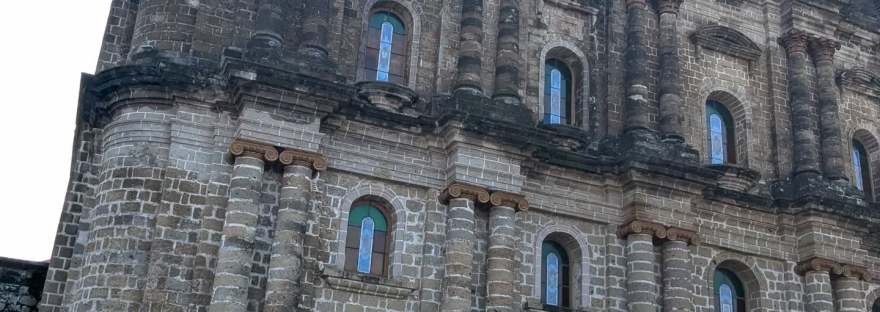
Mara: The Minor Basilica of Saint Martin of Tours — the Taal Basilica — is considered the largest church building in the Philippines, roughly 88.6 meters long and 48 meters wide, constructed beginning in 1856 and completed in 1878. Its walls are built largely of adobe and coral stone.
Pip: Adobe and coral stone held together, as the post explains, with lime mortar and egg whites. Which sounds like a recipe until you realize the building has been standing for over a century and a half.
Mara: There's historical documentation for it. A senior member of the photography club, who knows the area well, shared that detail on the walk. The National Historical Commission has since carried out restoration work — stabilizing walls and repointing gaps between the adobe and coral blocks — while trying to preserve the original masonry character.
Pip: So the geologist who came expecting to think about a volcano spent the morning reading the rocks in the walls instead.
Mara: The post puts it well: "What stories can these rocks tell?" That question — geology turned toward architecture and history — runs through the whole piece. The photowalk was also a mother-and-son first visit, which gives the whole morning that particular quality of seeing something genuinely new.
Pip: Fresh eyes, old walls. The combination works.
Mara: A living heritage town that keeps asking what stories its materials can tell — that's a question worth sitting with.
Pip: Next time, we'll see what other questions surface when a scientist points a camera somewhere unexpected.
Discover more from The Fabulous Scientist
Subscribe to get the latest posts sent to your email.


