
Grass Padrique | The Fabulous Scientist
I work with data.
I work with machine learning. I play around with AI and large language models. I spend a good portion of my working life staring at databases, spreadsheets, digital maps, subsurface data, and whatever other collection of zeros and ones has decided to make my day interesting.
So naturally, people (like my boss) sometimes ask me:
“Why do you still use a fountain pen?”
Fair question.
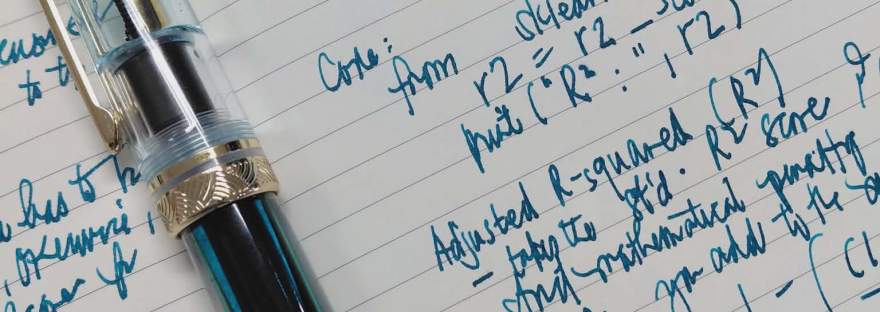
I’ve actually been asked a variation of this more than once—particularly when people see me writing notes by hand, sketching ideas on paper, or even writing down bits of code in a notebook.
And my answer is usually something along the lines of:
Because I like it.
Not particularly scientific, I know.
But the more I think about it, the more I realize that there’s actually something deeper going on.
And I’m beginning to notice that I’m not alone.
People who spend their lives surrounded by smartphones are buying fountain pens. People who have perfectly capable smartphone cameras are buying point-and-shoot cameras again. People are keeping paper planners, writing journals, buying notebooks, shooting film, listening to vinyl, and generally finding increasingly creative ways to put a little friction back into their lives.
What on earth is going on?
We Have Technology That Can Do Everything
The smartphone is probably one of the most incredible pieces of technology humans have ever put in our pockets.
My phone can take photographs, record video, scan documents, translate languages, navigate unfamiliar places, edit photographs, access my work email, browse the internet, store thousands of books, and probably do several other things I haven’t discovered yet.
It can also tell me that someone I haven’t spoken to since high school has just posted a photograph of their lunch.
Truly, civilization has peaked.
And yet, increasingly, I find myself deliberately reaching for something that can’t do any of those things.
A fountain pen.
There is something wonderfully stupid about this.
The fountain pen doesn’t have Wi-Fi.
It doesn’t have Bluetooth.
It doesn’t have an operating system.
It doesn’t even know what a notification is.
Its entire technological ambition is essentially:
“I will put this liquid on that paper.”
And somehow, that’s exactly the point.
The Problem With a Device That Does Everything
The problem with having a device that can do everything is that it can also distract you from doing anything.
Take my phone.
I can pick it up because I want to take a photograph.
Five minutes later, I could be checking email.
Then Messenger.
Then Instagram.
Then the weather.
Then some completely unrelated reel about how to make Krispy Kreme donuts crispy? In fact I just watched this more than an hour ago while I was waiting for my pork sinigang (a type of sour pork stew) to cook.
And suddenly I’ve forgotten why I picked up the phone in the first place.
The same thing happens when you’re trying to write.
You open your laptop because you want to jot down an idea.
Then there’s an email.
Then a notification.
Then a Teams message.
Then you remember something you need to Google.
And before long, you’ve spent twenty minutes being extremely productive at doing things you never intended to do.
A notebook doesn’t do that.
You open it.
You write.
It doesn’t ask you to update anything.
The Joy of Doing One Thing
This, I think, is one reason people are rediscovering old-fashioned tools.
A fountain pen has one job.
A notebook has one job.
A point-and-shoot camera has one job.
And strangely enough, the limitation becomes the attraction.
When I bring a dedicated camera with me, I’m not carrying the entire internet in my pocket. I’m carrying something whose primary purpose is to make photographs.
When I use a fountain pen, I’m not trying to optimize my handwriting for searchability, accessibility, cloud synchronization, or artificial intelligence.
I’m simply writing.
And that little bit of friction changes the experience.
You have to slow down.
You have to think.
You have to decide what is worth writing down.
You have to compose the photograph rather than simply spraying hundreds of images and hoping that one of them survives the algorithmic culling process.
The inconvenience becomes part of the experience.
Which Brings Me to Fountain Pens
I’ve become rather obsessed with fountain pens.
This is probably not news to anyone who has read my other posts.
I have accumulated an assortment of pens that, if examined objectively, probably raises questions about my financial priorities.
But there’s something about writing with a fountain pen that digital tools simply don’t reproduce.
The nib moves across the paper.
The ink flows.
Different inks behave differently.
Some shade. Some sheen. Some shimmer.
The paper has texture.
And your handwriting changes depending on the pen you’re using.
It is a physical interaction between hand, pen, ink, and paper.
And perhaps most importantly, there is no undo button.
That sounds terrifying to someone who has spent years working with digital data.
But it is also liberating.
You make a mistake.
You cross it out.
You keep going.
There is something strangely human about that.
“But You Work With Machine Learning!”
Exactly.
This is probably the part that confuses people the most.
How can someone who is interested in machine learning and data science still insist on writing things down on paper?
Shouldn’t I be using an iPad? (Actually, I do have two right now, for reading ebooks, drawing mind maps, and as secondary monitor to my MacBook.)
Shouldn’t everything be searchable?
Shouldn’t my notes be digitized, synchronized, backed up, analyzed, tagged, indexed, and perhaps eventually interpreted by an LLM? (Truth be told, some of them are – use Copilot Notebook and NotebookLLM for highly technical books and notes.)
But here’s the thing:
Not every thought needs to become data.
Sometimes I need to think before I organize.
When I’m working through an idea, especially something complicated, I don’t always want a perfectly formatted digital document.
I want to draw arrows.
Make boxes.
Cross things out.
Write something in the margin.
Draw a completely unnecessary diagram.
Circle something three times.
Write:
“THIS IS IMPORTANT!!!”
And then, three days later, wonder what I was so excited about.
Paper gives me permission to think messily.
And messy thinking is often where good ideas begin.
The Same Thing Happens With Photography
I’ve also noticed this with photography.
Smartphones have made photography almost effortless.
And that’s fantastic.
But because taking a photograph is so easy, we sometimes take photographs without really looking.
A dedicated camera changes that.
Even a tiny point-and-shoot makes you stop for a moment.
You raise the camera.
You look through it.
You compose.
You decide.
Click.
There’s a tiny ritual involved.
And rituals can be valuable.
They tell our brains:
Pay attention. This matters.
It’s one of the reasons I enjoy photography so much.
I’m not particularly interested in taking the technically perfect photograph every time.
Sometimes I simply want to notice something.
A street.
An old building.
A curious shadow.
A cup of coffee.
A geological outcrop, because apparently I cannot walk past rocks like a normal person.
And take a picture of it.
We’re Not Rejecting Technology
I don’t think the resurgence of fountain pens, compact cameras, film photography, paper notebooks, and other “old” technologies means people suddenly hate technology.
Quite the opposite.
I think many of us love technology.
I certainly do.
I’m fascinated by AI and machine learning precisely because of what technology allows us to do.
But perhaps that’s why we’re also becoming more conscious of its cost—not necessarily in money, but in attention.
We’ve spent decades making everything faster.
Faster communication.
Faster photography.
Faster writing.
Faster information.
Faster everything.
And now we’re discovering that sometimes faster isn’t better.
Sometimes we want to take our time.
Sometimes we want to write slowly.
Sometimes we want to compose a photograph.
Sometimes we want to sit with an idea instead of immediately searching for the answer.
Sometimes we want to use a tool that doesn’t demand our attention every few seconds.
Perhaps It’s Not Analog vs. Digital
I’ve come to think that this isn’t really a battle between analog and digital.
I love my digital cameras.
I love computers.
I use machine learning.
I use AI.
I work with data.
I am perfectly capable of spending an unreasonable number of hours in front of a screen.
But I also love my fountain pens.
I love notebooks.
I love paper.
I love the feeling of deliberately making something with my hands.
The real distinction, perhaps, isn’t analog versus digital.
It’s intentional versus automatic.
You can use the most sophisticated digital technology in the world and still be completely intentional about it.
And you can use a fountain pen while compulsively checking your phone every thirty seconds—which rather defeats the purpose.
The tool isn’t necessarily the answer.
The attention we give to the activity is.
The Beautiful Absurdity of It All
There’s a funny irony here.
Technology has spent decades trying to eliminate friction from our lives.
And now some of us are paying good money to buy it back.
We buy fountain pens that require bottled ink.
We buy notebooks when Google Docs is free.
We buy cameras that are less computationally capable than the phone already sitting in our pockets.
Some of my friends still buy film and then pay someone to develop it.
We deliberately make things harder.
And perhaps that’s because the friction is what makes us present.
A fountain pen doesn’t make writing more efficient.
A point-and-shoot camera doesn’t make photography more convenient.
But they can make those activities feel more deliberate.
And in a world where everything is optimized for speed, engagement, convenience, and endless scrolling, maybe there is something wonderfully rebellious about doing something slowly.
So yes, I work with machine learning.
Yes, I am fascinated by AI.
Yes, I spend my days dealing with data.
And yes, I still carry a fountain pen.
Because sometimes I don’t want an algorithm.
I want ink.
Sometimes I don’t want computational photography.
I want to look through a little viewfinder and press a shutter.
Sometimes I don’t want my thoughts instantly searchable.
I just want a notebook.
And sometimes, in a world where our phones are constantly asking us to look at them, I think it’s rather nice to have something that asks us to look at the world instead.
Perhaps that’s why the fountain pen and the little camera are making a comeback.
They’re not necessarily better tools.
They’re simply quieter ones.
And these days, quiet is becoming a rather luxurious feature.
xoxo,
Grass

Discover more from The Fabulous Scientist
Subscribe to get the latest posts sent to your email.


