Grass Padrique | The Fabulous Scientist
I almost bought another camera.
There. I said it.
For someone who already owns a Fujifilm X-T20 and an Insta360 GO Ultra, not to mention two smartphones (never mind that one of them is old), this probably sounds like the beginning of a very familiar story among photographers:
“I don’t actually need another camera, but hear me out…”
And believe me, I had a very good argument prepared.
I was seriously considering the Kodak PIXPRO WPZ2, a small rugged point-and-shoot camera that is waterproof, dustproof, and shockproof. It seemed like the perfect little companion for outdoor adventures, especially for someone like me who occasionally goes places where cameras are expected to encounter rocks, rivers, mud, rain, and other things that camera manufacturers probably consider “hostile environments.”
The price was around ₱12,000 (~195 USD) in Lazada.
And I was very close to convincing myself that this was a perfectly reasonable purchase.
Then I asked ChatGPT.
And surprisingly, ChatGPT talked me out of buying a camera.
This may be the first time artificial intelligence has actually saved me money instead of helping me find another thing to buy.
Why Was I Looking for Another Camera?
Let’s establish something first.
I already have cameras.
My Fujifilm X-T20 is my proper photography camera. It produces beautiful images, gives me interchangeable lenses, and is the camera I reach for when image quality matters.
Then there’s my Insta360 GO Ultra, which is almost the opposite kind of camera.
It’s tiny, waterproof, wearable, and ridiculously convenient. I can bring it hiking, walking, traveling, or doing anything where carrying a conventional camera feels cumbersome. It’s my “capture the experience” camera.
I used both cameras for the Taal Heritage Town Photowalk our Photography Club did last August 21.
So why on earth was I looking for a third camera?
Because both have limitations.
The X-T20 is not something I want to dunk in a river. It’s just not weatherproof, one of its limitations.
Also, I love it too much. It may be old and bought secondhand but still, I spent precious pesos to get it and it really capture great photos. It’s my first mirrorless camera too.
And while the GO Ultra is waterproof and incredibly versatile, its ultra-wide lens can introduce noticeable distortion toward the edges—even when shooting in Linear mode. That’s fine for action footage and immersive video, but it isn’t always what I want when I’m documenting something where straight lines and proportions actually matter (e.g. fault planes or bedding planes on a rock outcrop, fossils).
And then there’s macro photography.
The GO Ultra isn’t really a macro camera.
This matters to me because I’m a geologist.
Give me a rock and my instinct is apparently to get as close to it as possible.
A little closer.
No, closer.
Closer.
“What mineral is that?”
“What’s that texture?”
“Is that a vein?”
“Are those vesicles?”
“What is that weird little thing growing on the surface?”
You get the idea.
So I started looking at rugged point-and-shoot cameras.
And the Kodak PIXPRO WPZ2 seemed to tick many of the boxes – waterproof, dustproof, shockproof, small, simple, has optical zoom, and has Macro mode. Not to mention it’s the only branded rugged digital camera I can purchase online at the moment.
Basically, a little camera that I could throw into my field bag and take to places where I would hesitate to bring the Fuji.
It made perfect sense.
Until I remembered something.
I already owned one.
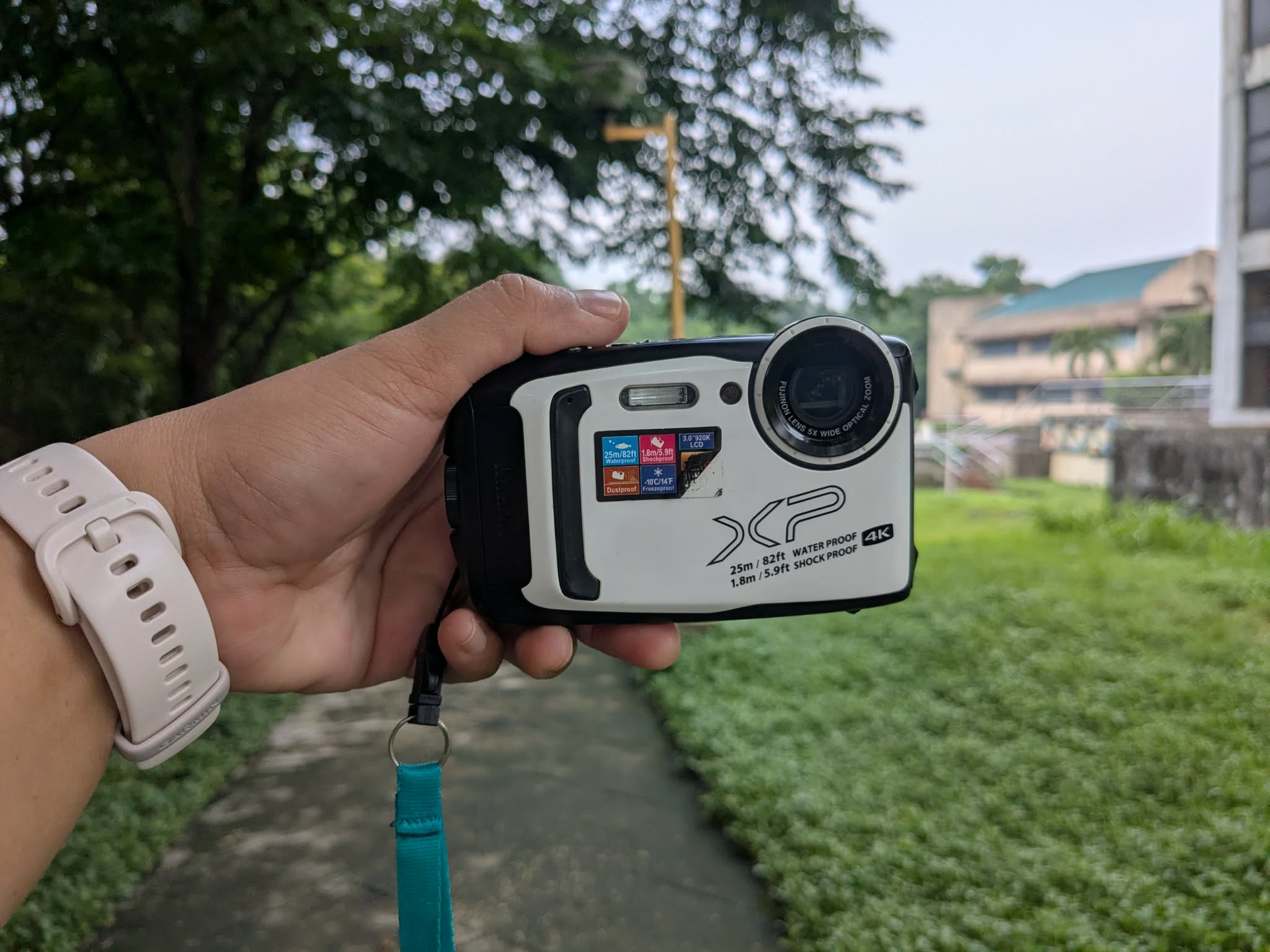
Meet My Old Fujifilm XP140
I have had my Fujifilm FinePix XP140 for seven years. It’s an older rugged compact camera that I hadn’t used in quite a while. Actually, the last time I used it was when we went on a beach and snorkeling trip in Coron, Palawan, in 2023 with family.
In my mind, it was basically an old gadget sitting in a drawer somewhere, waiting patiently for retirement.
Then I started talking to ChatGPT about the Kodak.
ChatGPT asked me what I had.
I mentioned the XP140.
And that changed the entire conversation.
“Wait,” essentially became the response.
“Why are you buying the Kodak? Your XP140 already does most of this—and in several ways, it’s actually better.”
So I dug out the old Fuji.
I charged the battery.
Fortunately, I even had a spare battery, bought in preparation for the Coron trip.
I turned it on.
And…
It worked.
The camera still functions perfectly.
The zoom works.
The autofocus works.
The screen works.
The macro mode works.
The camera takes photographs.
Suddenly, my ₱12,000 Kodak purchase started looking considerably less necessary.
The Comparison I Didn’t Expect
I asked ChatGPT to compare my old XP140 with the Kodak WPZ2.
And this is where things became interesting.
| Feature | Fujifilm FinePix XP140 | Kodak PIXPRO WPZ2 |
|---|---|---|
| Sensor | 1/2.3″ CMOS | 1/2.3″ BSI CMOS |
| Resolution | 16.4 MP | 16.35 MP |
| Optical zoom | 5× | 4× |
| Equivalent focal length | 28–140 mm | 27–108 mm |
| Macro | ~9 cm | ~5 cm |
| Waterproof | 25 m / 82 ft | 15 m / 49 ft |
| Shockproof | 1.8 m / 5.9 ft | 2 m / 6.6 ft |
| Dustproof | Yes | Yes |
| Freezeproof | −10°C | No equivalent rating |
| Stabilization | Optical | Digital |
| Video | 4K | 1080p |
| LCD | 3.0″, 920K dots | 2.7″, 230K dots |
| RAW | No | No |
| Wi-Fi | Yes | Yes |
| Bluetooth | Yes | No |
And there it was.
My supposedly outdated camera wasn’t actually inferior to the new Kodak.
In some areas, it was better.
The XP140 has a longer 5× optical zoom, optical image stabilization, 4K video, a larger and much higher-resolution LCD, Bluetooth, and a deeper waterproof rating.
The Kodak’s biggest advantage for me was its closer macro capability, with a minimum focusing distance of around 5 cm compared with roughly 9 cm for the XP140.
That was useful.
But was it worth ₱12,000?
Probably not.
The Moment I Realized I Didn’t Need Another Camera
There is something humbling about discovering that your “old” camera is still perfectly capable of doing the job you were about to buy a new camera for.
We have become so accustomed to technological obsolescence that we often assume:
Old = inferior.
Newer must be better.
Newer sensors.
Newer processors.
Newer stabilization.
Newer everything.
But sometimes the old gadget sitting in your drawer is perfectly happy to say:
“Excuse me. I can still do that.”
And my XP140 apparently could.
In fact, after testing it, I started thinking about the three cameras I already own differently. Below are some of the snapshots I took today using my XP140.
The Fujifilm X-T20
This is my photography camera and just like my XP140, also an already phased out model from more than 5 years ago.
When I want beautiful images, interchangeable lenses, control, and the best image quality of the three, this is the one I want.
But I’m not taking it swimming.
Or into a muddy river.
Or crawling around a wet outcrop.
At least, I don’t want to.
The Insta360 GO Ultra
This is my experience camera.
It’s tiny, waterproof, wearable, and excellent for video and POV photography (e.g. when I’m painting or walking).
It lets me capture things that would be difficult or impossible with a conventional camera.
But its wide-angle perspective can produce edge distortion, even in Linear mode, and it’s not designed for close-up macro work.
The Fujifilm XP140
And now I have rediscovered its role.
This is my field camera.
It’s small.
It’s rugged.
It’s waterproof.
It has an optical zoom.
It has a macro mode.
And because it’s already several years old, I don’t feel like I’m carrying around a precious piece of equipment every time I go near a muddy river.
That’s a pretty useful combination.
But Why Did I Want a Rugged Point-and-Shoot in the First Place?
This is probably the most important question.
Because, technically, I already had a waterproof camera.
The GO Ultra.
So why did I feel the need for another one?
Because “waterproof” isn’t the same thing as “a good waterproof still camera.”
The GO Ultra is fantastic at capturing an experience.
But sometimes I want to deliberately photograph something.
A rock outcrop.
A mineral.
A fossil.
A river.
A geological contact.
A weathered surface.
A little detail on an old building.
Something where I want a more conventional perspective and the ability to zoom optically.
And sometimes I don’t want the distortion of an ultra-wide action camera.
I want to point the camera at something and say:
“That’s the photograph.”
That’s where a rugged point-and-shoot makes sense.
The XP140 gives me a nice middle ground between the two.
I don’t have to risk the X-T20.
I don’t have to accept the ultra-wide perspective of the GO Ultra.
And I don’t have to spend another ₱12,000.
My Geologist Brain Is Particularly Happy
The more I think about it, the more appropriate the XP140 is for me.
Geologists spend a lot of time in places that are not exactly camera-friendly.
Rivers.
Outcrops.
Forests.
Muddy trails.
Rain.
Dust.
Rocks.
When you’re photographing geological features, the camera isn’t just recording a pretty scene. You’re often documenting something that you may need to inspect later.
That’s when having a small rugged camera becomes useful.
I can photograph an entire outcrop.
Zoom into a feature.
Get reasonably close to a mineral or texture.
Take photographs beside a river.
And not spend the entire time worrying about whether my expensive camera is about to meet its geological fate.
And Then There Was ChatGPT
Here’s the funny part.
I’m someone who works with machine learning, AI, and data.
I spend my professional life thinking about how technology can help us make better decisions.
And in this case, I actually used AI to make a very mundane decision:
Should I buy this camera?
Instead of simply encouraging the purchase, ChatGPT helped me compare what I wanted against what I already had.
And the conclusion was:
Nope. You already have it.
That’s not exactly the kind of AI story we usually hear. We’re constantly hearing about AI helping people become more productive, generate content, analyze data, write code, create images, and automate tasks. But perhaps one of the more useful applications is something much simpler: helping us stop buying things we don’t need. The best purchase decision isn’t always finding the best new product.
Sometimes it’s discovering that the product you already own is good enough.
₱12,000 Saved
So I didn’t buy the Kodak.
Instead, I bought—or rather, will buy—a fresh SD card for my XP140.
That’s considerably cheaper.
I already have an extra battery.
The camera works.
And after testing it, I am genuinely excited to take this old little Fuji out again.
Perhaps it deserves a second life.
Maybe I’ll take it on my next photowalk.
Maybe it’ll accompany me on a geological field trip.
Maybe I’ll deliberately take it somewhere wet and muddy just because I can.
And if it gets a little dirty?
I’ll wash it.
That’s the beauty of having a rugged camera.
The funniest part is that this whole episode reinforces something I’ve been thinking about lately.
We’re surrounded by incredibly sophisticated technology.
AI.
Machine learning.
Computational photography.
Cloud computing.
Smartphones that can do almost everything.
And yet sometimes the smartest thing we can do is use the simple thing we already have.
So thank you, ChatGPT.
You saved me ₱12,000.
And more importantly, you reminded me that my old Fujifilm XP140 wasn’t obsolete.
It was just waiting in the drawer for another adventure.
Postscript: I suppose there’s an important lesson here for my fellow fountain-pen addicts.
If I ever tell you I’m thinking about buying another pen because I “really need one with a different filling system,” please remind me about the ₱12,000 camera.
Actually, never mind.
I probably need the pen. Or I probably can now buy a pen with the money I saved because of ChatGPT. (Just kidding, or not.)
xoxo,
Grass

Discover more from The Fabulous Scientist
Subscribe to get the latest posts sent to your email.


