Grass Padrique | The Fabulous Scientist
I normally take a jeepney to work.
Partly because it is the cheapest way to get around, and partly because I genuinely enjoy riding with the locals of Muntinlupa. There is something about traveling with people from here that I find comforting. They seem more laid-back, more easygoing, and somehow friendlier than the people I usually encounter in bigger, busier cities.
Sometimes, riding a jeepney through Muntinlupa doesn’t feel like being in a city at all. It feels a little bit like being in the province.
And I like that.
This morning’s ride though was different.
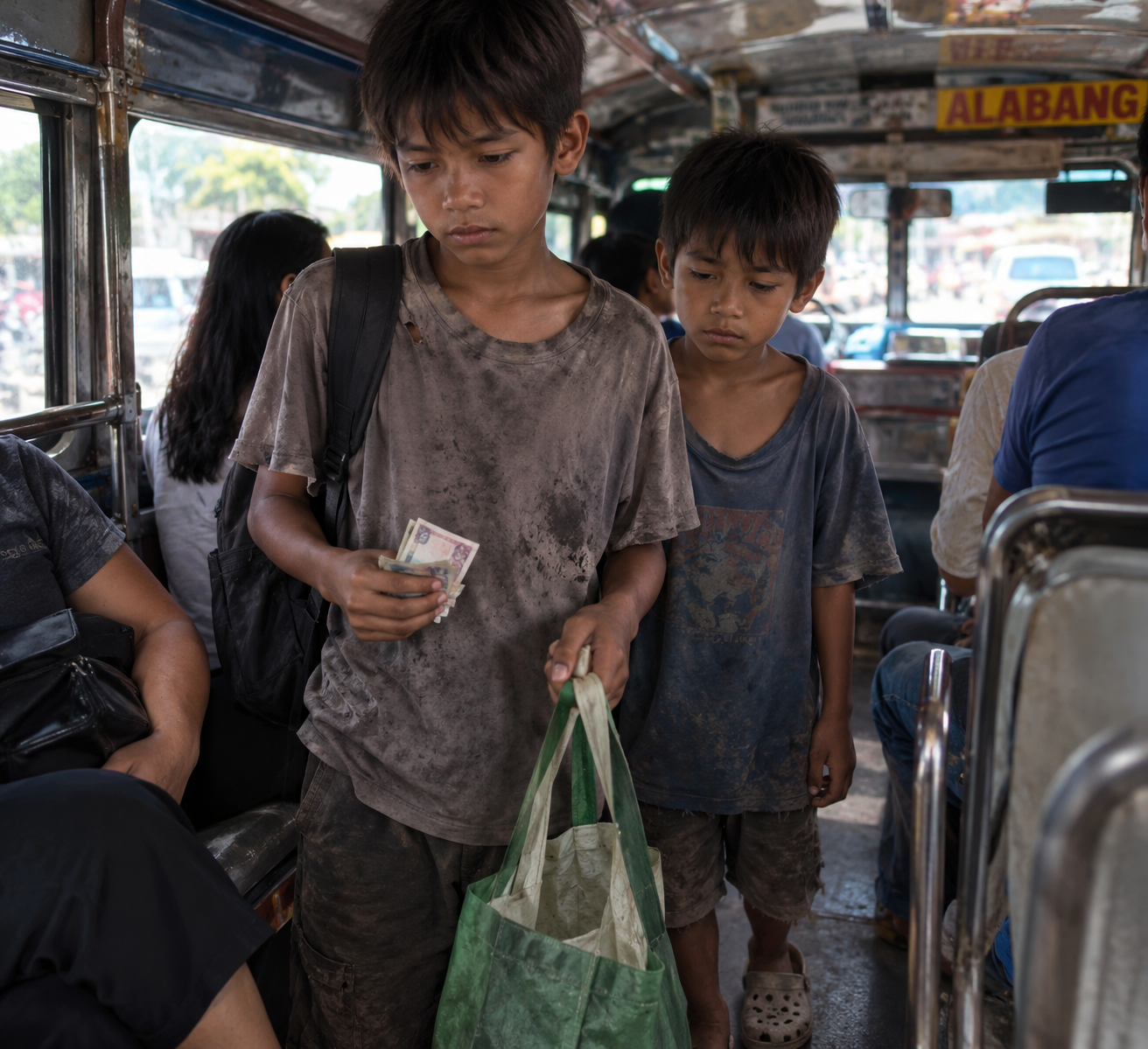
Halfway through the trip, two young boys got on the jeepney. They looked around ten and twelve years old. They were carrying what appeared to be a reusable shopping bag, and the older boy had a few hundred pesos in his hand.
What struck me was how tired they looked.
It was still early in the morning, yet there was something heavy in their eyes. Their clothes were old and worn, their feet muddy, and they were wearing inexpensive slip-on shoes that looked like imitation Crocs.
I assumed they were probably headed to the nearby public market in Alabang.
And I couldn’t help wondering:
Why were two such young boys being sent to the market by themselves?
Where were their parents?
Why weren’t there any adults with them?
Then, rather unexpectedly, I remembered myself.
I Had Been Those Kids
Decades ago, I was in almost exactly the same position.
I was the eldest child in our family. My mother was pregnant and taking care of my younger siblings, so I was often the one sent to the public market to buy food for the family.
We were living in a squatter’s area at the time.
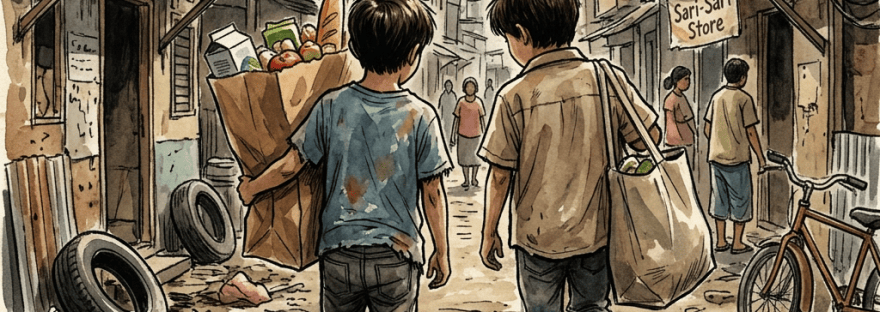
One day, I had a particularly long list of things to buy, so my younger brother had to come with me. We went from store to store, carrying bags that probably felt enormous to two little kids.
I still remember one particular store where we used to buy eggs. The woman behind the counter saw us struggling with the bags and suddenly blurted out:
“Kawawa naman kayo. Nasaan ang mga magulang ninyo? Ang bigat ng mga dala ninyo!”
“Poor kids. Where are your parents? Those bags look heavy!”
My younger brother immediately started crying.
Not because the bags had suddenly become heavier.
I think it was because, for the first time that day, someone had made him feel the weight of our situation.
He sensed the pity in the woman’s voice.
And suddenly, he felt sorry for himself.
Which, to be fair, was probably a perfectly normal reaction for a little boy who would much rather have been outside playing with his friends than spending his morning carrying groceries.
But we had no choice. Someone had to buy the food.
And sometimes, when you grow up poor, childhood comes with responsibilities that aren’t supposed to belong to children yet.
Poverty Has a Way of Speeding Up Childhood
Looking back, I think poverty made us mature faster.
Not necessarily wiser.
Not necessarily stronger.
Just… faster.
We learned things earlier than we probably should have.
I learned how to budget money because I had to make sure the money given to me was enough to buy everything on the list.
I learned how to navigate the public market.
I learned how to look after my younger siblings.
I learned to be responsible for their safety when my parents weren’t around.
I learned that if my younger brother got lost, hurt, or into trouble, I couldn’t simply shrug my shoulders and say, “I’m just a kid too.”
Because I was the eldest.
And somehow, being the eldest meant being the adult when the adults weren’t available.
I remember having to take care of my younger siblings when my parents had somewhere to go. I was still a child myself, but there were moments when I didn’t have the luxury of behaving like one. Even my neighbors couldn’t help but comment about our situation – why I was just a kid but had to take care of very young siblings. I didn’t have the time for play!
While other kids in the neighborhood were simply being kids, I was learning responsibility.
Perhaps that’s one of the strange things about growing up with very little.
You don’t necessarily lose your childhood.
But you sometimes have to share it with adulthood.
This Morning, I Saw Myself
And that is what struck me most about those two boys on the jeepney.
I don’t know their story.
Maybe they were simply sent to buy groceries.
Maybe their parents were waiting for them at home.
Maybe they were doing a small errand before school.
I shouldn’t assume too much from the few minutes I saw them.
But I recognized something.
The tiredness.
The seriousness.
The way the older boy held the money and the shopping bag as though he understood that losing either one would mean trouble.
I recognized that look because I had worn it myself.
And suddenly, I wasn’t just looking at two children going to the market.
I was looking at a younger version of myself.
A little girl carrying a shopping list.
A younger brother beside her.
A heavy bag.
A few pesos that had to stretch far enough.
And an adult looking at us and realizing that we were carrying more than children should have to carry.
What Poverty Teaches—and What It Shouldn’t Have To
I sometimes think that people who grew up with more privilege and people who grew up with less can emerge from childhood with very different ideas about responsibility.
When you have very little, you learn early that money has limits.
That food has to be planned.
That younger siblings need looking after.
That sometimes you can’t have what you want because there are more important things to pay for.
You learn resourcefulness.
You learn resilience.
You learn to make do.
But I don’t romanticize poverty.
There is nothing beautiful about a child having to grow up too quickly.
Yes, those experiences shaped me. They made me responsible. They taught me how to budget, care for others, and navigate difficult situations.
But I wouldn’t wish the circumstances that taught me those lessons on another child.
Children deserve to be children.
They deserve to complain about being sent on errands because they’d rather be playing.
They deserve to carry school bags instead of grocery bags that are too heavy for them.
They deserve to worry about homework and playground games—not whether the family’s food budget will stretch until tomorrow.
And Then the Jeepney Ride Continued
Eventually, the boys got off.
The jeepney continued along its route, with passengers coming and going as they normally do.
And I sat there thinking about how strange life is.
Sometimes you encounter someone for only a few minutes, and they remind you of an entire chapter of your life.
Those two boys probably have no idea that their morning trip to the market made a woman on a jeepney remember her childhood.
That little girl who once carried heavy grocery bags with her younger brother grew up, went to college, became a geologist, learned about rocks and minerals, eventually found herself working with data and artificial intelligence and still remembers the weight of those bags. The weight of poverty.
Funny how memory works.
Sometimes it doesn’t return as a photograph.
Sometimes it returns as a jeepney ride.
And sometimes, all it takes is seeing two tired little boys carrying groceries to remind you how far you’ve traveled.
I hope those boys got home safely.
I hope the bags weren’t too heavy.
And I hope that someday, when they look back on this morning, they remember not only how hard life was but also how much they managed to carry.
Because sometimes, we don’t realize how strong we were as children until we meet our younger selves again.
Mine happened to be sitting across from me on a jeepney this morning.
Discover more from The Fabulous Scientist
Subscribe to get the latest posts sent to your email.


