
Grass Padrique | The Fabulous Scientist
A little warning before you read on: The stories I’m about to share involve ghostly encounters, mysterious apparitions, tragic deaths, and some rather disturbing events. If you’re easily frightened or not particularly fond of horror stories, you might want to leave the lights on while reading this one. You’ve been warned!
If you’ve been around my blog for a while, you’d know that I’m a visual storyteller—or simply someone who enjoys sharing stories with the world. It could be a review of fountain pens I like, the inks I’ve recently tried, or my journey as a scientist here in the Philippines. Naturally, I also enjoy keeping the conversation going by listening to other people’s stories, especially those who generously spare some of their time for long conversations in this ever-busy world.
So when the UP Diliman Alumni Relations Office announced an immersive storytelling tour happening on November 6, I signed up right away. I told my husband about it, who is also a UP alumnus, and he signed up, too.
The event was a wonderful opportunity for us to take another one of our regular fitness walks around the campus, except this time, we’d be revisiting familiar places while listening to stories we probably wouldn’t hear during an ordinary daytime stroll. And since we both spent our university years there, we were particularly excited to see the campus in a different light—or, more appropriately, after dark!
On the day of the event, we were told that more than 10,000 people had signed up, but only 250 lucky participants were given slots for the tour. How lucky were we!
The evening started with registration at Quezon Hall, just behind the famous Oblation statue, which we fondly call Oble. We were assigned to groups based on the confirmation emails we had received, and each group was provided with snacks consisting of pasta and fruit juice. We then waited for the sun to set because, naturally, this was a walking tour that was meant to happen after dark.
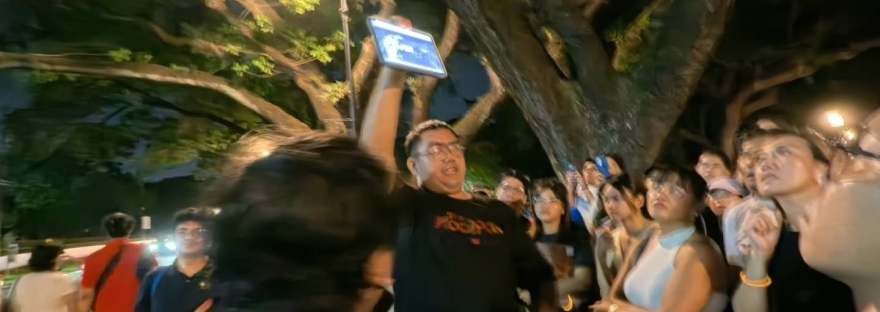
After a few safety reminders and a short message from the head of the Alumni Relations Office, we finally began our walk, with each group following its assigned storyteller.
A Walk Through UP Diliman’s Darker Corners
Our first stop was the Faculty Center, whose renovation is still ongoing following the devastating fire that gutted the building a few years ago. The storyteller showed us a photograph of the horrific fire while he told stories of how voices were heard while the fire was happening as if the ghosts of the building were in utter despair amidst the raging blaze.
I actually passed by the Faculty Center the morning of the fire. That day, I was on my way to my son’s school for a parent-teacher meeting. I remember seeing the building collapsed right in the middle with the firemen still flushing the whole structure with water from their high pressure hoses. A huge part of the building was still engulfed in flames. The saddest scene was the heartbreaking expressions of professors and students as they watched it burn. Thousands of books, research materials, and academic papers accumulated by students and professors were lost that day. It was a painful reminder that buildings are not merely structures; they also hold years of knowledge, memories, and hard work.
Our second stop was Palma Hall (Arts and Science), where we heard stories of student activism and how its steps and halls were barricaded during Martial Law. We also heard about the ghost of a former Theatre student who was said to haunt the Wilfrido Ma. Guerrero Theater. Apparently, even after leaving the university, some people never quite leave the stage! One notable story I heard within its halls was that of a student who was peeing in one of the bathroom stalls in the fourth floor. She felt something hit his forehead and when she looked up, there was a ghostly woman hanging from the ceiling above her.
Next was Benitez Hall (College of Education), a building one of the participants described as neoclassical in design. Here, we heard about a supposed ghostly apparition with glowing red eyes that had occasionally been spotted in one of its rooms. The particularly unsettling part? Some claimed that you could catch a glimpse of it by peering through the room’s keyhole and looking back at you would be the red glowing eyes.
There was also a painting of a former dean that was rumored to have been made using his ashes. According to the stories, people had noticed that the portrait would sometimes move. I’m not sure I’d be particularly eager to verify that story by standing in front of the painting! It was also mentioned during the tour that Benitez Hall used to be a garrison by the Japanese military during World War II.
We then proceeded to Vinzons Hall, where one of the second-floor bathrooms was reportedly haunted. However, for me, the most disturbing story associated with this building wasn’t about a ghost. It was about a writer for Kule, UP’s student publication, who was reportedly bludgeoned to death inside the publication’s office. I am not sure what eventually happened to the case, but the incident took place a few years after I graduated from UP.
At the College of Law (Malcom Hall), we heard accounts of a typewriter that could supposedly be heard moving and typing inside one of the rooms, even when nobody was there. Imagine hearing the familiar clacking of a typewriter in an otherwise empty room. Perhaps someone was still working on an unfinished case!
At the steps of the College of Engineering, or Melchor Hall, the stories took a much darker turn. We heard accounts of fraternity hazing and violent frat wars, including one incident in which at least seven frat members from two warring frats reportedly lost their lives.
Our next stop was Abelardo Hall, home of the College of Music. Here, people had reportedly heard musical instruments playing on their own inside supposedly empty rooms. We also heard a particularly disturbing account of a limbless and headless human torso that was allegedly found abandoned near the building many years ago.
By this point, I was beginning to appreciate just how many stories, both supernatural and otherwise, were tucked away in the familiar buildings and corridors of the university.
When Reality Is More Frightening Than Ghost Stories
Of all the stories we heard that evening, however, the ones that stayed with me the most were not about ghosts, apparitions, or mysterious sounds. They were about real people who lost their lives within the campus.
When I was still an undergraduate, a student was gunned down along the covered walkway of Palma Hall after reportedly being mistaken for a fraternity member. I will never forget the commotion that followed, particularly the sight of frightened students running away from the scene as the gunmen fled.
There was also an incident involving a student who was run over by a car driven by intoxicated students in front of a dormitory while an event was taking place. I remember visiting her wake at the UP Chapel on her second night there. I never forgot her face in her coffin, she looked like she was peacefully sleeping. I prayed hard for her family that night.
These were not stories passed around as campus legends. They were incidents that happened during my years at UP, and some of them are memories I have carried with me ever since.
A Different Kind of Haunting
Overall, kaDILIMAN was a fascinating way to rediscover a university campus we thought we already knew so well. Walking through its familiar buildings after dark, listening to stories about ghostly encounters and unexplained happenings, gave us an entirely different perspective of a place that had been such a significant part of our lives.
But as much as I enjoyed the spooky tales, I realized that UP Diliman’s darkest stories were not necessarily about the ghosts and ghouls said to roam its corridors. They were about the violence, tragedies, and untimely deaths that had taken place within its grounds. To date, there are still student activist who remained missing, after being abducted.
Perhaps that’s what makes places like UP Diliman so fascinating. Every building has a history, every corridor has witnessed countless lives, and every generation leaves behind stories that become part of the university’s collective memory. Some are worth celebrating, some are worth remembering, and others are simply too painful to forget.
We came to the tour expecting to be frightened by ghosts. Instead, we were reminded that the past can be just as haunting as any ghost story.
And if there’s one thing I learned that evening, it’s that sometimes, the scariest things about a place are not the things we cannot see, but the things that actually happened there.
Would I recommend the tour? Absolutely! Especially if you’re a UP alumnus or someone who enjoys history, storytelling, and a little bit of the supernatural. Just remember to bring your walking shoes, keep an open mind, and perhaps avoid looking through too many keyholes along the way. We were also given a travel journal passport that we could stamp after each tour (see photos below). The organizers said that a similar tour will be conducted again in the future so please follow the UP Diliman Alumni Relations Office’s Facebook page for announcements.
After all, you never really know who—or what—might be looking back.
Here are photos from the tour:
Discover more from The Fabulous Scientist
Subscribe to get the latest posts sent to your email.


