Pip: The Fabulous Scientist is where geology and fountain pens share a field notebook, and somehow that makes complete sense.
Mara: Today we're covering a piece from fabulousgrass that sits right at the intersection of scientific practice and craft — how geologists have always written, sketched, and mapped by hand, and why that tradition still matters.
Pip: Let's start with the notebook, the nib, and the rock.
Writing Like a Geologist: Field Notes, Maps, and the Fountain Pen Tradition
Pip: The question this post is really asking is whether handwriting in the field is just nostalgia — or whether there's something genuinely irreplaceable about ink on paper when you're standing next to an outcrop.
Mara: The post frames it clearly from the start: "The first scientific instrument we ever used was not a tablet or GPS device — it was our own attention, guided by the quiet movement of pen across paper."
Pip: That reframes the whole conversation. It's not about resisting technology — it's about what the act of writing actually does to your attention.
Mara: Right, and the post grounds that in real field experience. The notebook wasn't decoration — it was the record. Strike, dip, contact zones, weather, even the food available near the outcrop. Everything lived there before it became a map or a thesis chapter.
Pip: Ink especially, because — and this is the part that stuck with me — you can't erase it.
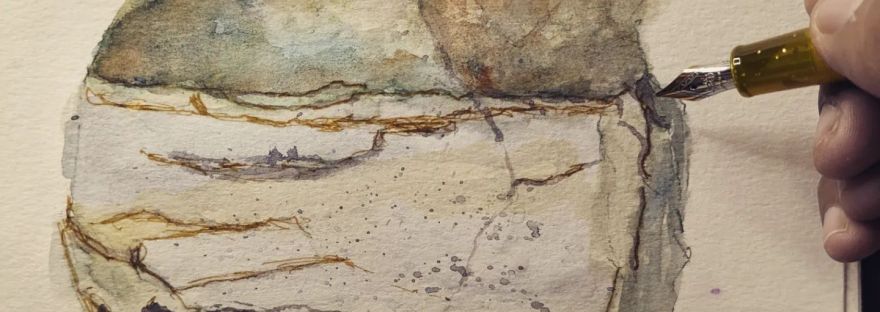
Mara: That's exactly the point the post makes about fountain pens specifically. Each stroke is a commitment, mirroring the way a geologist commits to an interpretation of a formation or contact zone. The line has personality: natural variation in width and pressure that pencil doesn't quite replicate.
Pip: So the tool is doing cognitive work, not just cosmetic work. Which is also why the post cites actual neuroscience — Mueller and Oppenheimer, Van der Weel and Van der Meer — on how handwriting produces broader brain connectivity than typing.
Mara: And that research connection isn't incidental. Teaching students to sketch with pen and notebook was a deliberate pedagogical choice — slowing them down, making them look closer, getting them to ask questions mid-drawing.
Pip: There's something almost subversive about that in a curriculum full of GIS dashboards.
Mara: The post also walks through what hand-drawn geological maps actually required before digital tools: patience, clean linework, consistent symbology, fountain pen annotation for fault traces, watercolor for depth. Many of those maps survive in university archives today.
Pip: A hybrid of precision and artistry — which is a good description of the whole tradition the post is trying to recover.
Mara: And it offers practical entry points for anyone: sketch a garden corner using field symbols, keep a daily observation notebook, experiment with ink and watercolor wash on good paper.
Pip: The science of attention is really what's underneath all of this — and that connects directly to how we teach observation in the first place.
Mara: What stays with me is that the notebook was always doing double duty — evidence and memory at the same time.
Pip: Ink as commitment. That's a principle that travels well beyond geology. More from The Fabulous Scientist next time.
Discover more from The Fabulous Scientist
Subscribe to get the latest posts sent to your email.


