
A caldera is a large, basin-shaped depression. It forms when a volcano’s magma chamber empties during a massive eruption. The overlying land then collapses into the void. It is different from a volcanic crater. A volcanic crater is a smaller, bowl-shaped depression. It typically forms by the explosive release of gases at the surface.
The formation of a caldera often results from violent volcanic eruptions. These eruptions eject huge amounts of magma, ash, and gases. This causes the structure of the volcano to become unstable.
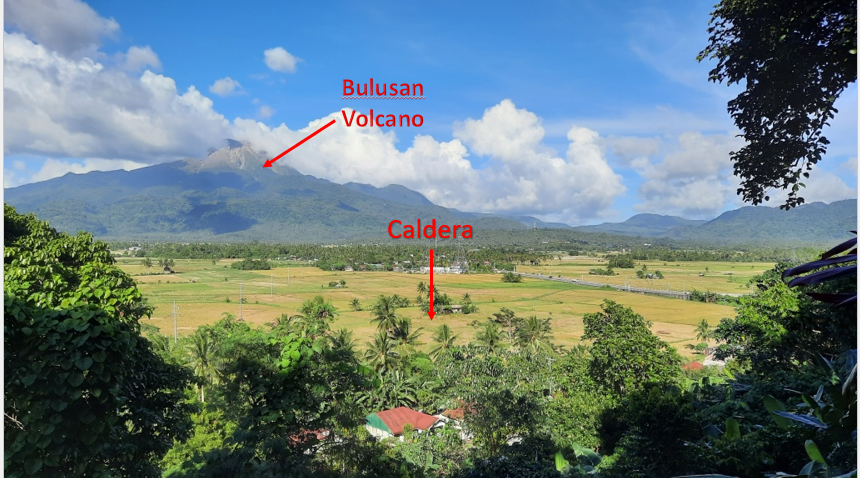
You are probably familiar with Taal Lake and Laguna Lake. As a Filipino, you might know they are both famous for being caldera lakes in Luzon, Philippines. But, have you ever heard of a dry volcanic caldera? We have one in the Philippines. It is now used as rice fields. These are located at the southeasternmost region of Luzon Island, the Bicol Region, which is literally a rice bowl. Here’s a summary of a paper by Kobayashi and others (2014) about this caldera in the first photo.
In case you’re not sure where Irosin caldera is, the photo below shows the more famous Bulusan Volcano. Based on geologic evidence, the volcano formed within the caldera.
According to Kobayashi and others (2014), Irosin caldera-forming eruption occurred approximately 41,000 years ago. This estimation is based on the AMS radiocarbon dating of a charcoal fragment within the ignimbrite layer. If you’re not sure where the charcoal fragment came from, it was formed from the burning of organic matter. This includes trees and plants burned by the hot materials from the volcano. The eruption is characterized by a sequence of events, including a precursory eruption and a main caldera-forming eruption.
1. Precursory Eruption: The initial phase included the ejection of fine ash. A small lava dome, called Malobago, was extruded on the southeastern slopes. This area is part of the present caldera. It is possible that similar lava extrusions occurred within the caldera. The composition of the Malobago lava dome is the same as the pumice from the Irosin ignimbrite. The time interval between the basal ash and the Plinian pumice is estimated to be less than 10 years. The ash is interpreted to be from the degassed part of ascending lava in a conduit.
2. Main Caldera-Forming Eruption: This followed a geologically short pause. This pause was likely within 10 years of the precursory eruption. It consisted of four phases.
a. Plinian Phase: The first phase of the main eruption was a Plinian eruption, likely within the present caldera. This resulted in the northward emplacement of pumiceous tephra, with a bulk volume of approximately 20 km³. Partial collapses of the Plinian column occurred repeatedly during the early stage. These collapses formed thin, fine-grained intra-Plinian flow deposits. These deposits are associated with fallout pumice layers. The upper part of the Plinian deposit consists of thinly accumulated ignimbrites that are fine-grained, cross-stratified, and contain accretionary lapilli. During the waning stage of the Plinian phase, a strong ground shaking event occurred. This resulted in disturbed structures at the base and in the upper horizon of the Plinian deposit.
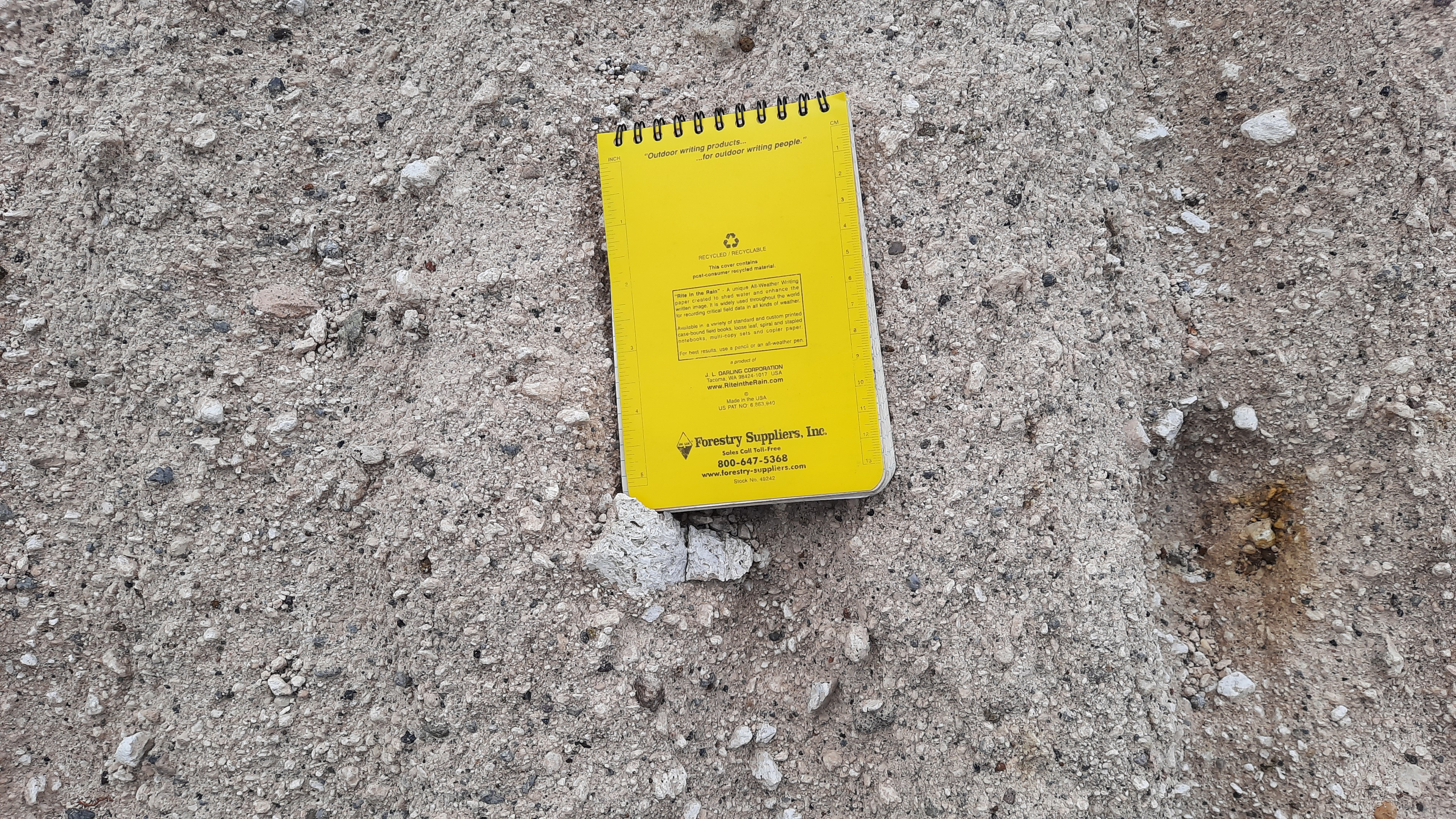
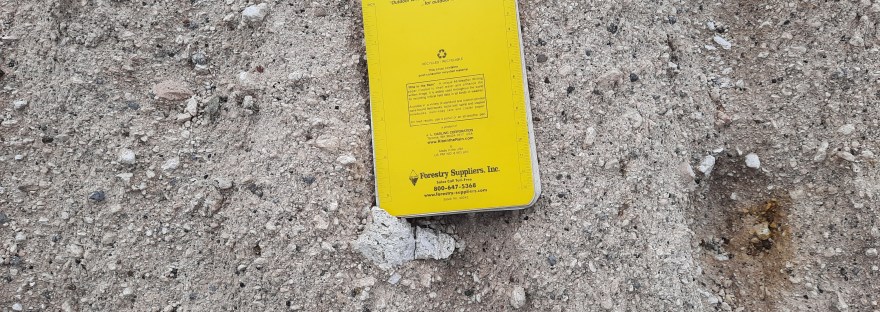
The photo above shows a close-up of the deposit from the caldera-forming eruption event of Irosin. This deposit can be found in Juban, Sorsogon. The white fragment just below my yellow notebook is a pumice fragment. We usually put ordinary objects on an outcrop, such as this notebook. We also use my hand lens before taking photos for size scale. So from this photo, it can be obvious that the pumice fragment is a few centimeters long. The black grains in this outcrop are volcanic glass fragments. These grains are molten magma that froze in the atmosphere during an eruption. A collapsed eruption column may have formed this deposit.
b. Lower Ignimbrite Phase: Following the Plinian phase, the lower Irosin ignimbrite was generated along with ground layers. This ignimbrite is generally fine-grained with a glassy matrix, containing small pumice, obsidian, and lithic clasts. It is underlain by a thin, discontinuous ground layer.
c. Upper Ignimbrite Phase: The final and most catastrophic phase involved the eruption of the upper Irosin ignimbrite. It formed the present caldera topography1. The upper ignimbrite is thick and coarse, with a coarse lithic concentration zone at its base1. This ignimbrite has a similar composition to the lower ignimbrite but contains coarser clasts910. Fresh rhyolitic blocks found in the deposit suggest a similar lava extrusion occurred within the caldera before the main eruption10.
d. Co-ignimbrite Ash Fall: Fine ash was elutriated during the ignimbrite phase. It was transported to the north and settled as a co-ignimbrite ash fall. This deposit was found on the Inascan scoria cone, about 80 km north of the caldera. The co-ignimbrite ash is composed of fine-grained glass shards with small amounts of phenocrysts. The total bulk volume of the erupted tephra from the Irosin caldera is large. It is estimated to be as much as 70 km³. This volume includes the Plinian pumice, ignimbrite, and co-ignimbrite ash.
The Irosin eruption started with a Plinian phase. Then, the final catastrophic eruption of the upper coarse ignimbrite formed the caldera. The total bulk volume of the erupted tephra is estimated at 70 km³. This corresponds to approximately 30 km³ DRE (dense rock equivalent). It also has a Volcanic Explosivity Index (VEI) of 6. The eruption was such a huge event that part of the ash reached around the area of Mayon Volcano!
Source: Kobayashi, T., et al. (2014). Eruptive Sequence and Characteristics of the Irosin Ignimbrite, Southern Luzon, Philippines. Journal of Geography (Chigaku Zasshi), 123(1), 123-132. doi:10.5026/jgeography.
Do you want to read more about Mayon Volcano and Irosin Caldera? Then check out this blog:
xoxo,
Grass
Discover more from The Fabulous Scientist
Subscribe to get the latest posts sent to your email.

 The Fabulous Scientist