
If you’ve seen my geologist portfolio, you may know that I’ve dedicated over half of my career as a professional geologist to the geothermal industry. My graduate research focused on enhancing traditional petrography techniques by integrating advanced image analysis and machine learning classifiers.
I haven’t been very active on LinkedIn, partly because I was deep into my graduate studies and didn’t have the time to “hang out” there. Now, as I’m in between roles, I’ve been inspired by fellow scientists who actively share their knowledge with the public—something we need more of, especially in the current landscape of misinformation. Reading Carl Sagan has also fueled this drive. So, I decided to post a conceptual model for students and geothermal enthusiasts on LinkedIn and my social media, hoping it serves as a resource for understanding geothermal systems.
This a video I made in Canva showing a conceptual model of a type of geothermal system – one underneath inactive/extinct volcanoes. I have also copied the post here verbatim (in Italics):
Yesterday, I noticed that the company I previously worked for has been actively promoting geothermal energy in Facebook and LinkedIn. This is great news, especially since one comment on their post asked why we are only now prioritizing geothermal energy, given its reputation as a clean, renewable resource. In fact, harnessing geothermal energy from deep within the Earth (at depths of around 2–3 km) has been ongoing since the 1960s in the Philippines. The comment underscored the need for greater public awareness about geothermal energy as a reliable electricity source here in the country.
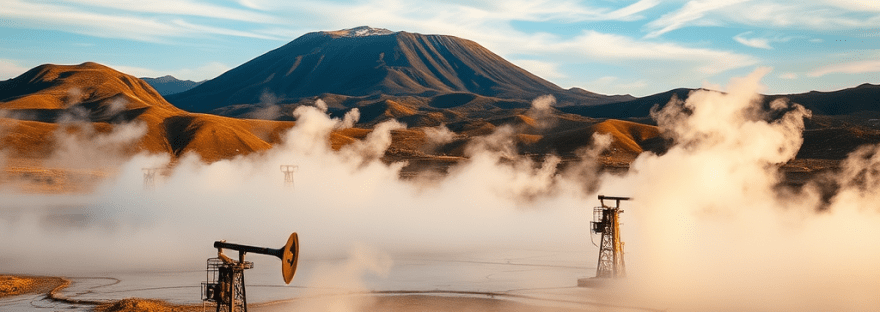
Below is a video I created on Canva, illustrating a simplified (promise, they are more complex than this) version of a high-temperature, stratovolcano-hosted geothermal system—the type common in the Philippines, original illustration used with permission from James Stimac, a geothermal energy expert. Here you will see that deep-seated water from rains (we call it meteoric water, represented by blue arrows) gets heated up by rocks that are unusually hot due to deeper magma underneath and because these heated waters (warm-colored arrows) are less dense, they go up towards the surface and sometimes, we encounter them as hot springs (think of hot springs in Los Banos, Laguna, green arrows). Some of these waters underneath are so hot (>220 degrees C) that the steam produced can turn the turbines in power plants to generate electricity. The Philippines is top 3 in the world in terms of geothermal energy production in MWe (ThinkGeonergy, 2023).
My MS research in Geology focused on understanding variations in porosity within these geothermal reservoirs, using detailed microscopic analysis of volcanic reservoir rocks. I’ll share more of this research in the coming days to help demystify this complex energy system, which currently supplies about 16% of our national electricity, according to the Department of Energy’s latest report (available on their website).
Additionally, I’ll be presenting a chapter of my MS thesis at GeoCon 2024, where I’ll discuss how convolutional neural networks (CNNs) can enhance traditional petrographic techniques for rating porosity and automatically detecting hydrothermal minerals in reservoir rocks obtained through drilling of wells. If you’re a fellow geologist attending the GeoCon 2024, do say hi!
As of this writing, the post has garnered over 12,000 impressions, reached more than 8,000 people, and has been reshared 35 times. It has also received thoughtful comments, primarily from geologists and a few consulting firm owners overseas. Notably, one of the new connections is the author of a paper I frequently referenced in my thesis—a researcher whose work inspired my pursuit of machine learning applications in geology. I felt honored to be added by her on LinkedIn. I hope that someday I will see her in one of the conventions I plan to attend to present my research.
Thanks for reading this far.
xoxo,
Grass
Discover more from The Fabulous Scientist
Subscribe to get the latest posts sent to your email.

 The Fabulous Scientist