

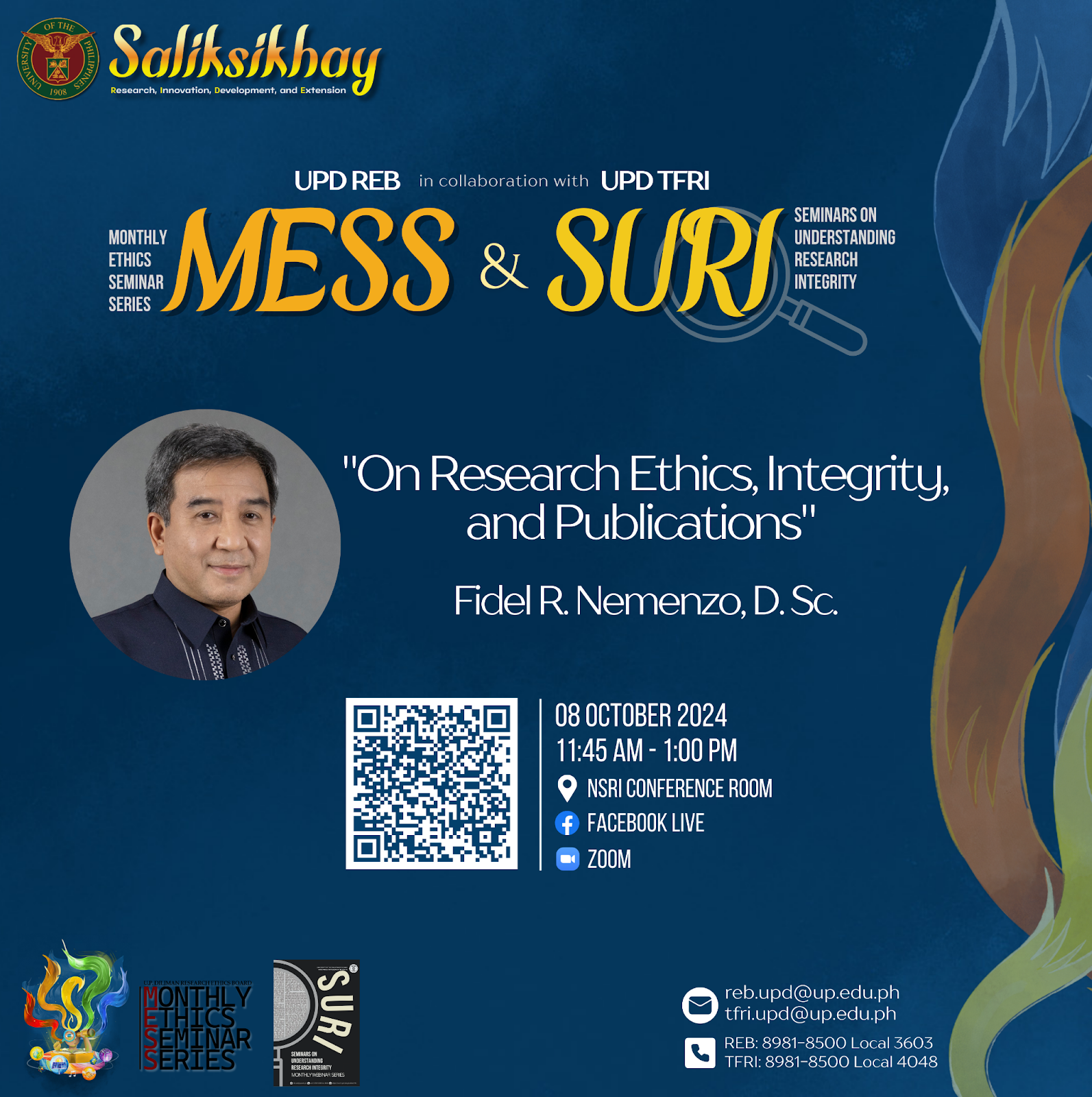
Last October 8 I attended an event hosted by the Research Ethics Boards (REB) of the University of the Philippines Diliman (UPD). It was the final session in a month-long series of seminars on research ethics and integrity. The keynote speaker was Dr. Fidel R. Nemenzo, a distinguished mathematician and former chancellor of UPD.
Although I had previously attended a similar event during my MS in Geology, I decided to attend this one as a refresher on ethical writing practices. However, I also had another purpose: to ask the former chancellor and the panel about the proper way to post about published work on social media. I’ve noticed that some researchers share their publications online, which I genuinely have no issue with—I’m thrilled to see fellow Filipino scientists being published in international journals. What bothers me, though, is when the prestige of the journal is highlighted, along with citation counts, and, worst of all, the mention of impact factor.
I’ve always believed that researchers and scientists should prioritize highlighting the societal impact of their work or how it contributes to a deeper understanding of the universe. That’s why I find it puzzling when researchers focus on metrics after getting published, often seemingly for academic promotion. I recently came across a Reddit thread discussing what it truly means to be a scientist, and it made me reflect on this issue:
I want to share my key takeaways from Dr. Nemenzo’s talk as well as that of the discussion panel members as a personal reminder to me whenever I write my research paper and for everyone out there who needs it. They are listed below:
Ethical Writing: Upholding ethics in writing fosters public trust in our work. This includes practicing honesty, objectivity, integrity, carefulness, openness, transparency, and accountability throughout the research and writing process.
Respectful Mentorship: Mentors are expected to guide their students or mentees with respect and responsibility, ensuring they receive proper ethical support and development.
Responsible Publication: Publish with purpose, not just for self-promotion or academic metrics. Be mindful of predatory journals and conferences that compromise the integrity of scholarly work.
Peer Review Integrity: Peer review is the foundation of reputable academic journals and a hallmark of ethical research, ensuring the credibility and quality of published work.
Social Responsibility: Your research should protect the rights and welfare of participants and aim to positively impact society. Ethical research contributes to the greater good and addresses societal needs.
Academic Freedom: Support the pursuit of knowledge while fostering a culture of intellectual diversity. Academic freedom encourages innovation and critical thinking, essential for ethical research.
Finally, here are examples of misconduct that he mentioned which sadly he also observed in the institution:
- Exaggerating Curriculum Vitae
- Misusing data for promotion
- Gaming citation counts
- Publishing in weak and predatory journals
- Attending predatory conferences for promotional points
I also feel like quoting this one from Dr. Nemenzo:
When a measure becomes a target, it ceases to be a good measure.
He said this in the context of researchers who focus too much on meeting targets and counting metrics (e.g. impact factor, publication counts).
What are your thoughts, folks?
Discover more from The Fabulous Scientist
Subscribe to get the latest posts sent to your email.

 The Fabulous Scientist