

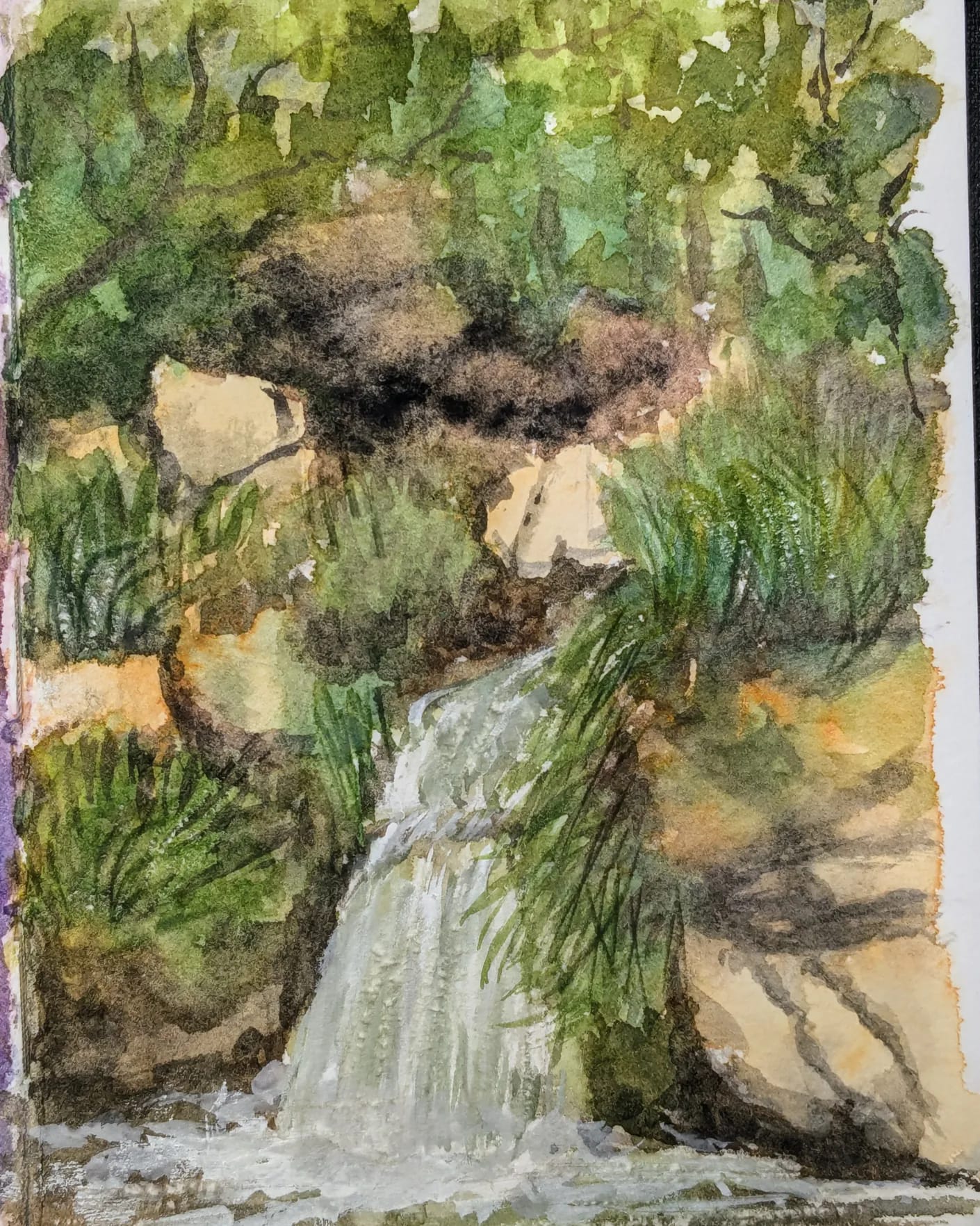
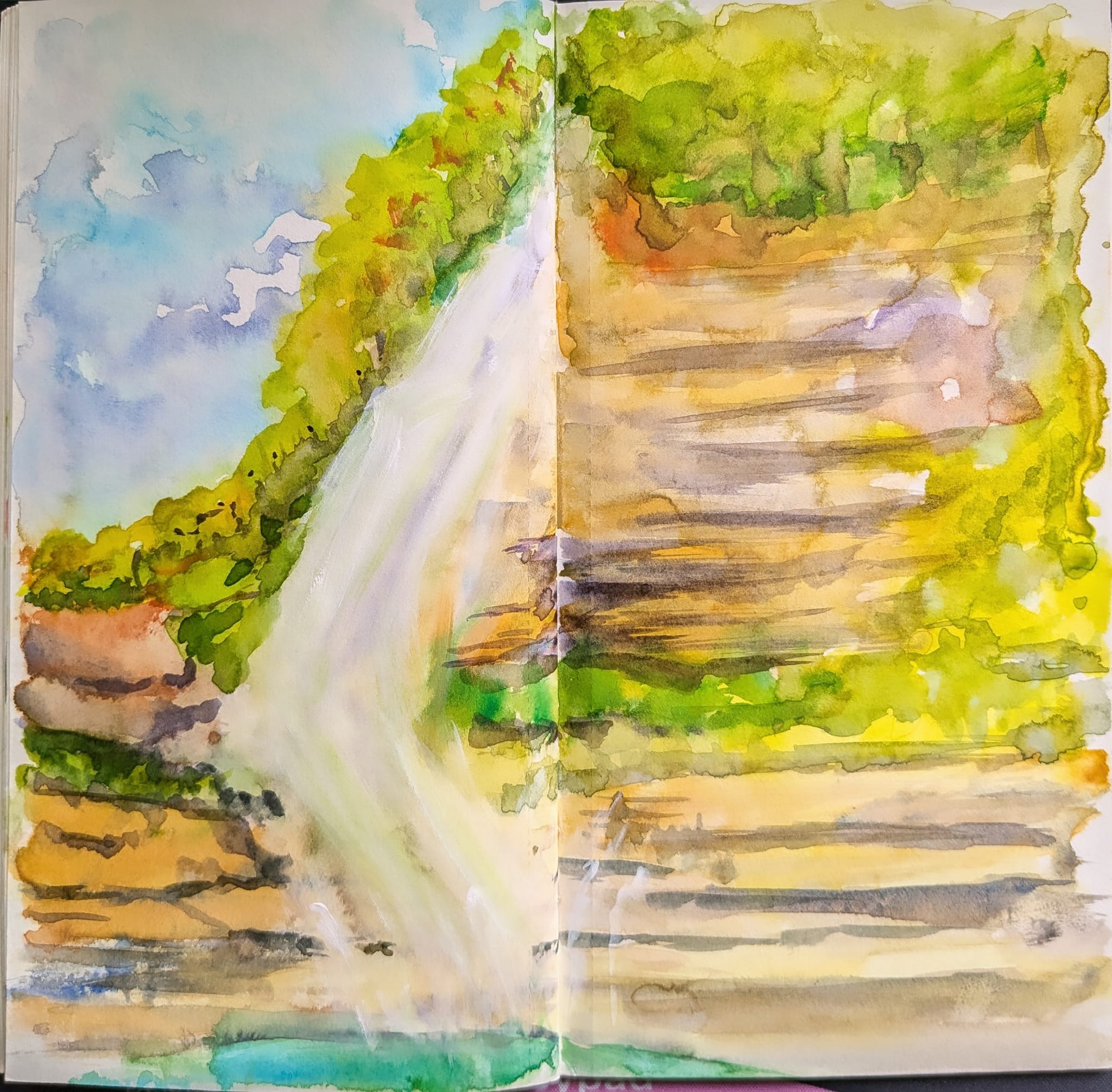
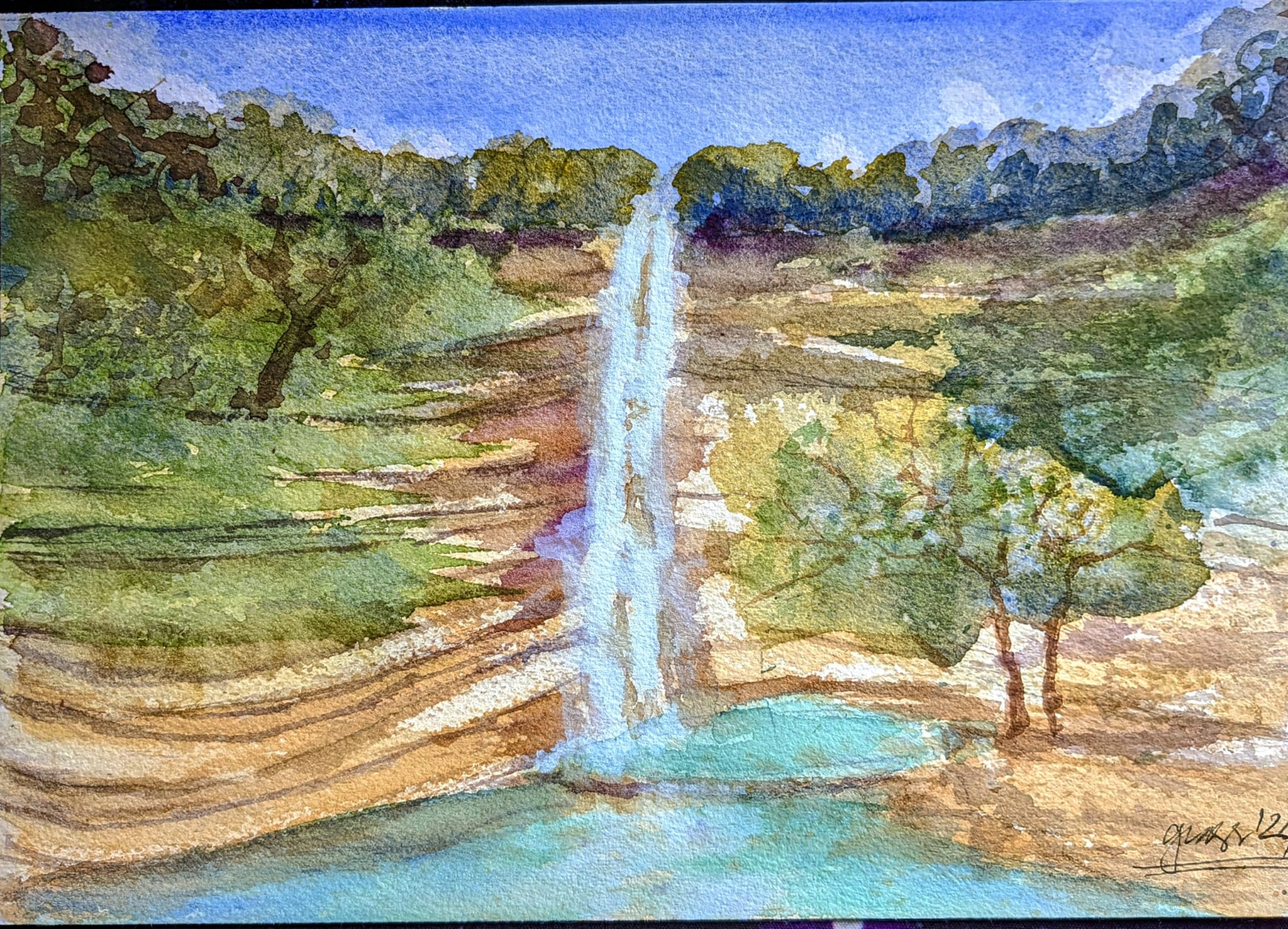
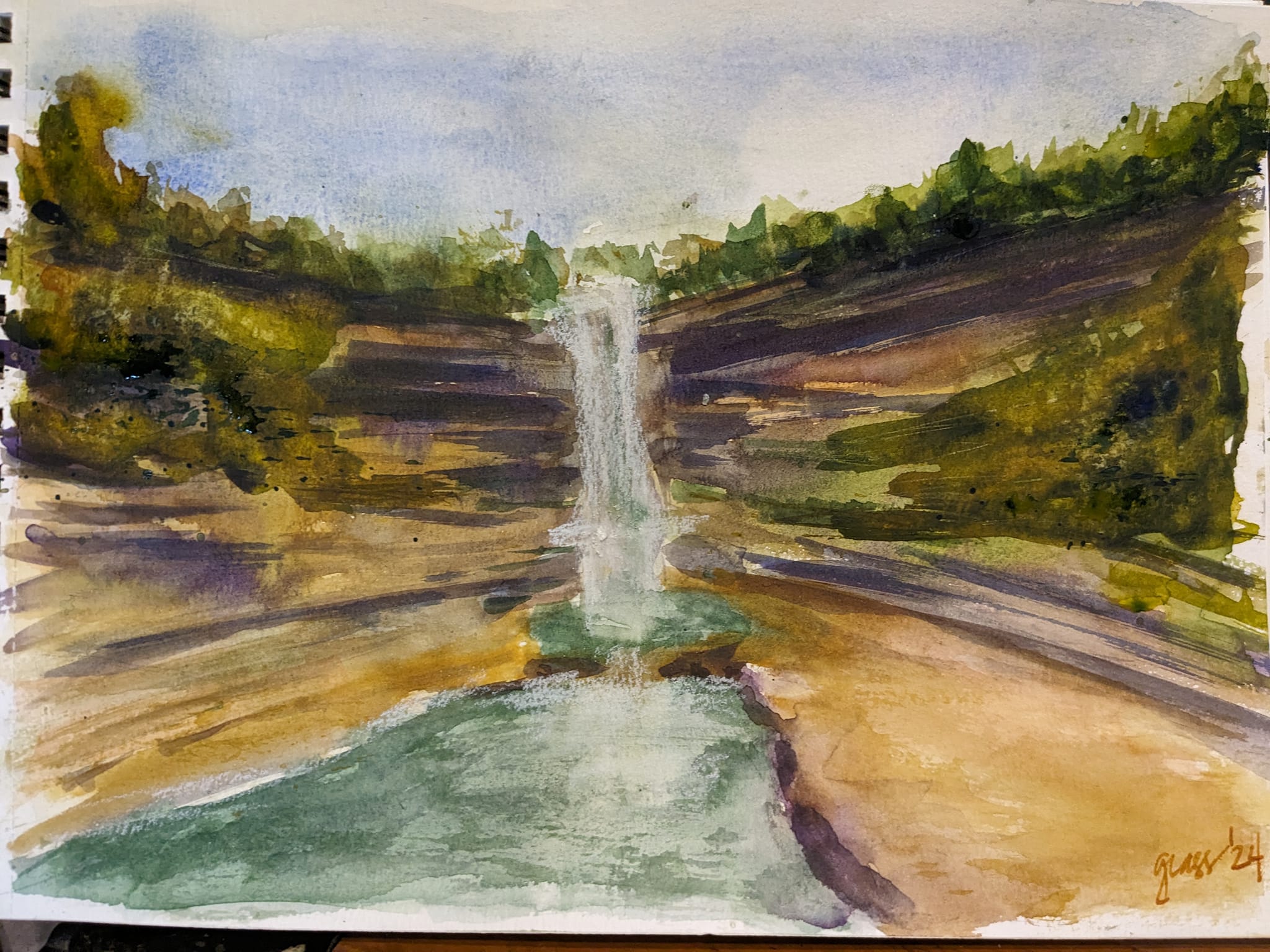
For some inexplicable reason, waterfalls became my favorite subject this week. There’s something undeniably captivating about them. As I reflected on why, I realized it ties back to a core childhood memory. I love the way rocks are often scattered at the waterfall’s base, the lush greenery surrounding them, the soothing sound of water crashing into the pool below, and the earthy smell of wet soil and moss. When I painted the first two pieces below, I aimed to capture these elements. The third painting offers a bird’s-eye view of a waterfall and its watershed beneath a pinkish sky, inspired by a piece I once saw on Pinterest—though I can’t recall the original artist. Don’t worry, I have no plans to sell these works. They’re just for practice, and they remain tucked away in my journals.

But first, let’s talk Geology. How do waterfalls usually form? Waterfalls form through a combination of geological processes, typically as a result of differences in the hardness or resistance of rock layers to erosion. Here is a basic explanation of how waterfalls form:
- Erosion and Differential Weathering: A waterfall usually begins to form where there is a contrast between hard, resistant rock layers and softer, more easily eroded rock. The river erodes the softer rock at a faster rate, creating a steep drop, which leads to the formation of a waterfall as the harder rock resists erosion longer than the softer layers beneath or around it (Ford & Williams, 2007).
- River Incision and Headward Erosion: As the river flows over these rock layers, the softer rock downstream erodes away, causing the harder rock above to eventually collapse, and the waterfall to retreat upstream. This process is known as headward erosion, where the position of the waterfall moves backward, further shaping the landscape over time (Twidale, 2004).
- Plunge Pool Formation: At the base of a waterfall, the force of the falling water can create a plunge pool by eroding the underlying softer rock. Over time, this deepens and expands, which can further undercut the waterfall and contribute to its retreat (Knighton, 1998).
During my work on geologic hazard mapping in Mindanao and parts of Central Luzon when I was still a young geologist, I noticed that several waterfalls in the country are structurally controlled. This means that when faults cause two blocks of rock to move vertically relative to each other, the displacement can alter the course of rivers, leading to the formation of waterfalls. In such cases, these waterfalls could be as old as the fault movement itself. While this is just a theory based on my local observations, it highlights how tectonic activity may shape these natural features.
Core Memory of Waterfalls
My earliest memories of experiencing the breathtaking beauty of our country were shaped during a journey to my parents’ hometown, Catanduanes, when I was just nine years old. In those days, reaching their quaint barrio required either a horseback ride or a long walk. I vividly recall the sense of distance as we trekked through the countryside, the hours stretching on until nightfall.
One of the most magical sights that I could never forget about the island during our treks there are when the trees were aglow with the flickering light of fireflies, casting an enchanting aura reminiscent of Christmas decorations. Amidst this natural light source, we found ourselves walking on the paved road without the need for flashlights or street lamps. The forest, adjacent to the paths we had trekked, was a realm of giants, with towering trees so vast that it would take the embrace of at least three adults to encircle their girth. The island is also famous for rocky shores and waterfalls.
My parents spent much of their childhood on the island, where they naturally became strong swimmers. They often shared stories of their adventures in forests filled with ancient trees of enormous size and girth, and tales of enchanted waterfalls where fairies were said to dwell. While that last part may have been a touch of fantasy, those storytelling days with my parents left me with a core memory of waterfalls as one of the most magical water bodies on Earth. It’s a memory that has inspired me, making waterfalls my favorite subject to paint in watercolors.
This week, for some reason, I found myself reminiscing about the times I spent swimming with my parents at the island’s waterfalls. Even now, I can hardly believe that freshwater shrimps the size of my hand once thrived in one of those waterfalls. I vividly remember my mom diving into the deep pool of one particular waterfall while my dad stood under the cascade, letting the water fall over his head and back. I wasn’t a swimmer then, so I stayed in the shallows, watching them play under the falls like children. Seeing me smile, my dad gently pulled me into the deeper water and helped me float. I still recall the powerful pull of the water beneath me—likely caused by the circulating currents beneath the falls. Stories of people drowning in that very spot were common, which made me develop a deep respect for waterfalls. Whenever I encounter one during fieldwork or travels around the Philippines, I’m reminded of their beauty, but also their treacherous depths for those who underestimate them.
These were the thoughts running through my mind as I painted the different waterfalls (gallery below) in watercolors and gouache—their mystery, their hidden depths, their sheer beauty, and the forests that sustain and protect them. I hope that those who visit these natural wonders will offer them the respect they deserve and take action to safeguard them from deforestation and pollution.





Cited References:
- Ford, D.C., & Williams, P.W. (2007). Karst Hydrogeology and Geomorphology. John Wiley & Sons.
- Twidale, C.R. (2004). River Terraces and Incised Valleys: Origin and Significance. Earth-Science Reviews, 67(3-4), 139-162.
- Knighton, D. (1998). Fluvial Forms and Processes: A New Perspective. Arnold Publishers.
Discover more from The Fabulous Scientist
Subscribe to get the latest posts sent to your email.

 The Fabulous Scientist